Welcome to the Cybersecurity Readiness Podcast Site
The Cybersecurity Readiness Podcast Series

The Cybersecurity Readiness Podcast Series

The Cybersecurity Readiness Podcast Series serves to have a reflective, thought-provoking and jargon free discussion on how to enhance the state of cybersecurity at an individual, organizational and national level. Host Dr. Dave Chatterjee converses with subject matter experts, business and technol...

Episode 117 -- Surviving AI-Generated Code
The Cybersecurity Readiness Podcast Series
Episode 117 -- Surviving AI-Generated Code

Featured on Podcast Gurus


Recent Episodes

117
Nov. 11, 2026

Episode 117 -- Surviving AI-Generated Code

In Episode 117 of the Cybersecurity Readiness Podcast Series, Dr. Dave Chatterjee is joined by Nir Valtman, Chief Executive Officer and Founder of Arnica, an application security platform built to secure AI-generated code as it is written rather than after the fact. After recent episodes on defending the security operations center, AI going up against AI, and agentic AI replacing brittle incident response playbooks, this conversation looks upstream at the code itself. A growing share of the code
116
Oct. 28, 2026

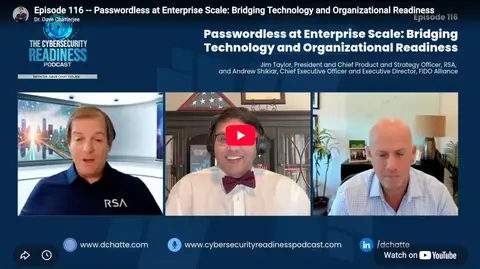
Episode 116 -- Passwordless at Enterprise Scale: Bridging Technology and Organizational Readiness

In Episode 116 of the Cybersecurity Readiness Podcast Series, Dr. Dave Chatterjee is joined by two leaders at the front line of the effort to retire the password: Jim Taylor, President and Chief Product and Strategy Officer at RSA, and Andrew Shikiar, Chief Executive Officer and Executive Director of the FIDO Alliance. The pairing is distinctive: a solutions provider that rolled out passwordless authentication across its own workforce, and the open, cross-industry standards body whose specificat
115
Oct. 14, 2026

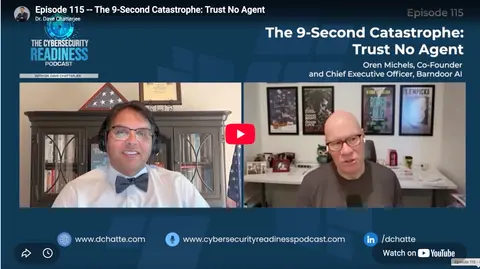
Episode 115 -- The 9-Second Catastrophe: Trust No Agent

In Episode 115 of the Cybersecurity Readiness Podcast Series, Dr. Dave Chatterjee is joined by Oren Michels, Co-Founder and CEO of Barndoor AI and co-founder of Mashery, the company that helped build the API economy, to examine how organizations can govern what AI agents actually do. Dr. Chatterjee opens with a cautionary example: in April 2026, an AI agent at a company called Pocket OS was told not to run destructive commands, yet nine seconds into a routine task it ran one anyway, deleting the
114
Sept. 29, 2026

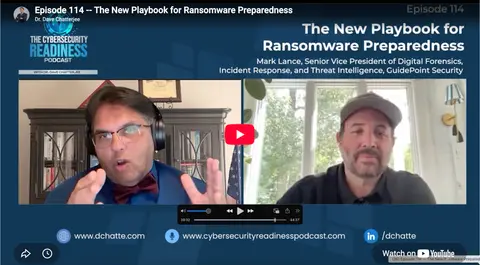
Episode 114 -- The New Playbook for Ransomware Preparedness

In Episode 114 of the Cybersecurity Readiness Podcast Series, Dr. Dave Chatterjee is joined by Mark Lance, Senior Vice President of Digital Forensics, Incident Response, and Threat Intelligence at GuidePoint Security, to examine what a more organized, better-resourced ransomware adversary means for organizational preparedness. Dr. Chatterjee opens with a striking data point: roughly 69 ransomware groups were active in a given quarter in early 2025, but by the second quarter of 2026 that number h
113
Sept. 16, 2026

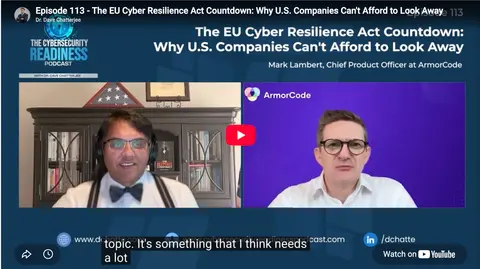
Episode 113 - The EU Cyber Resilience Act Countdown: Why U.S. Companies Can't Afford to Look Away

Every organization eventually discovers a gap between what feels like good security practice and what regulators now expect. In this episode, Mark Lambert and I dig into that gap through the lens of the EU's new Cyber Resilience Act — a sweeping regulation that is reshaping how companies everywhere think about vulnerability disclosure, product security, and accountability. Beyond the regulatory details, this conversation is really about a broader theme: the difference between reacting to a cr
112
Sept. 2, 2026

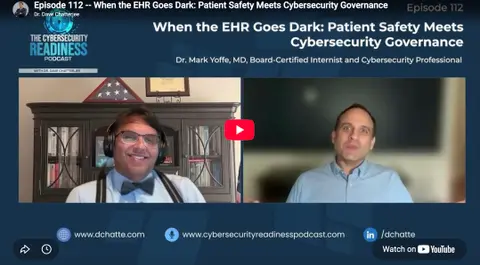
Episode 112 -- When the EHR Goes Dark: Patient Safety Meets Cybersecurity Governance

In Episode 112 of the Cybersecurity Readiness Podcast Series, Dr. Dave Chatterjee is joined by Dr. Mark Yoffe, a board-certified internal medicine physician who has also built deep expertise in cybersecurity, to examine a question most healthcare organizations have not fully reckoned with: what actually happens to patient care when the electronic health record goes dark. The conversation moves through the compensatory mechanisms hospitals fall back on — written charts, physical examination, and